You didn’t rage-quit your water app.
You just turned off notifications one day, and a month later you noticed the app icon was still there, unopened, doing nothing. No dramatic deletion. Just silence.
The 1-star reviews don’t tell the real story
Scroll the reviews for almost any water reminder app and paywall complaints dominate the 1-star pile. That’s the loud failure, the one people bother to type out. But it’s not the biggest failure. The bigger one is silent: someone downloads the app, gets pinged every 30 to 60 minutes regardless of what they’re doing, and within a week they open Settings and switch notifications off. They don’t write a review. They don’t delete the app either, not right away. They just stop engaging with it. The app has no idea it lost them, because nothing was reported. It just went quiet.
That’s the real churn number nobody puts on a landing page: not how many people rated the app poorly, but how many people are still technically “users” with the app installed and notifications muted, functionally gone.
What nagging actually costs
A reminder every 30 minutes isn’t a nudge, it’s noise. And noise trains you to ignore the source, which is the opposite of what a reminder is supposed to do. Once you’ve swiped away the same notification ten times in a row without reading it, your brain has already learned to filter it out. By the time it might actually be useful, say, you genuinely haven’t had water in three hours, you’ve already tuned it out along with everything else from that app.
The failure mode isn’t that people hate water apps. It’s that most water apps fire on a timer instead of on a signal, and a timer doesn’t know or care whether you already drank, whether you’re asleep, or whether it’s the fifth time today.
What a polite reminder actually looks like
Four rules separate a reminder that helps from one that gets muted:
| Behavior | Nagging pattern | Polite pattern |
|---|---|---|
| After you log a drink | Keeps firing on the same fixed timer | Resets the countdown, since you just did the thing it was reminding you to do |
| Once you hit your daily goal | Keeps pinging anyway | Goes quiet, because the job for today is done |
| During sleep or “do not disturb” hours | Fires anyway | Respects quiet hours completely |
| Weekday vs weekend | Same schedule both days | Can split, since a Tuesday and a Saturday aren’t the same day |
Put together, that’s the difference between a reminder system and an alarm clock that doesn’t know what day it is. A polite reminder behaves like it’s paying attention to you, because it is.
Why guilt mechanics make the nagging worse
Some apps stack a second problem on top of nagging: guilt. A plant wilts if you fall behind. A character starts crying. It’s meant to be motivating, and briefly it might be, but it turns every missed reminder into a small punishment instead of a neutral nudge. Combine an aggressive notification schedule with a guilt mechanic and you get the fastest path to silent churn there is: annoyed, then ashamed, then gone, in that order, with no review left behind to explain why.
Compare that to a paywall complaint. When a free feature suddenly demands a subscription, people are angry enough to type out a review about it, which is exactly why paywall complaints dominate the 1-star pile in this category. Nagging notifications and guilt mechanics rarely generate that same anger. They generate quiet disengagement instead, which is arguably the worse outcome for the app, because at least a bad review is a signal you can act on.
How WaterDrop’s reminders actually work
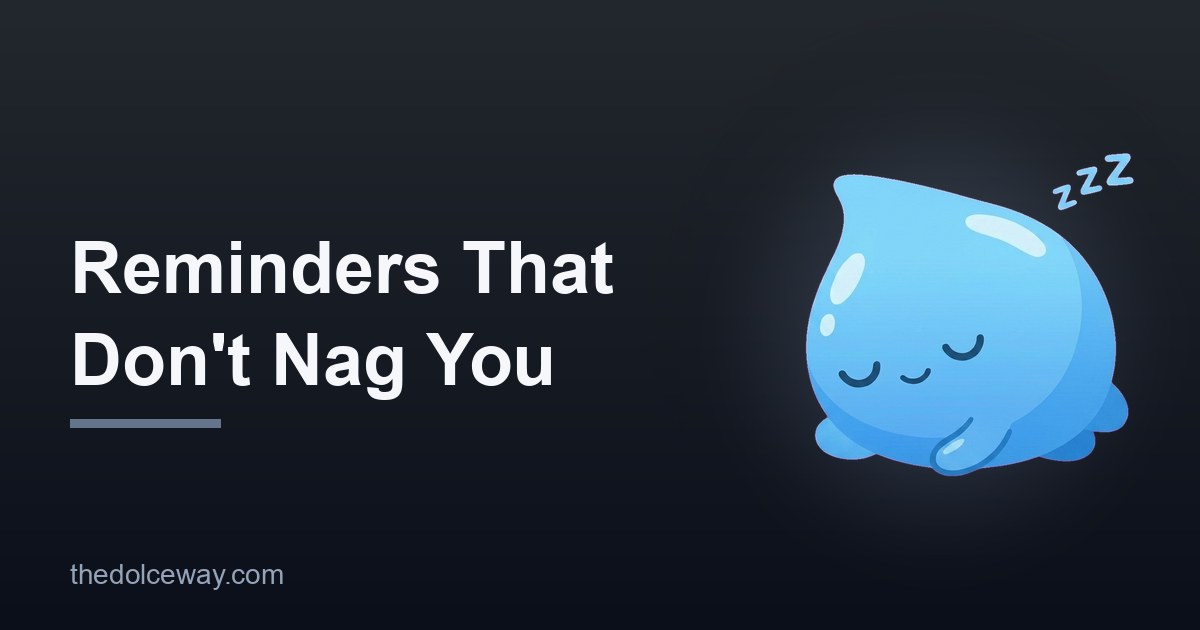
No guilt mechanic exists in the app, on purpose, there’s a build check that fails if anyone ever adds one. On top of that, the reminder logic itself follows the four rules above: it resets when you log a drink, it stops once you’re at your goal for the day, it respects quiet hours completely, and it can run a different schedule on weekdays versus weekends. The mascot, Droplet, celebrates when you hit your goal and sleeps quietly during your quiet hours. It never has a sad state to guilt you with, because there isn’t one to have.
The goal isn’t to send fewer notifications for the sake of a marketing bullet point. It’s to send notifications that are actually still worth reading by the third one, because the app has been paying attention to whether you needed it.
FAQ
Why do water reminder apps get muted so often? Most fire on a fixed timer that doesn’t account for whether you already drank, whether you’re asleep, or whether you’ve already hit your goal. Once a notification gets ignored a few times in a row, people mute the whole app rather than adjust the settings.
Is silent notification-muting worse than a 1-star review? For the app, yes, in a sense. A bad review at least tells you what went wrong. Muted notifications and quiet abandonment leave no signal at all, so the underlying problem never gets fixed.
Can a water reminder be smart without being creepy or complicated? Yes. It just needs a handful of simple rules: reset on log, stop at goal, respect quiet hours, and optionally split weekday and weekend schedules. None of that requires weather data, location tracking, or AI, just attention to timing.
Do I have to give up reminders entirely to avoid being nagged? No. The fix isn’t turning reminders off, it’s using ones designed to go quiet on their own once they’ve done their job for the day. Most people who mute a water app didn’t want zero reminders, they wanted the app to stop treating every hour the same.
How would I even know if I’m a silent churn case? A simple check: open your notification settings and see if the water app is muted. If it is, and you haven’t opened the app in weeks despite it still being installed, that’s the pattern. It’s more common than the app’s review page would suggest.
Related reads:
- 5 Best Water Reminder Apps for iPhone: how the major apps handle notifications
- How to Actually Drink More Water: why “set reminders” alone isn’t enough advice
- How to Build a Water Drinking Habit: the streak side of the same silent-churn problem
- Best Time to Drink Water: a rhythm reminders should adapt to, not fight
Sources
- Institute of Medicine — Dietary Reference Intakes for Water
- Harvard T.H. Chan School of Public Health — The Nutrition Source: Water
This article is general information, not medical advice. Talk to a qualified professional about anything affecting your health.
— Dolce
Comments
Comments powered by Giscus. Sign in with GitHub to comment.