I’ve tried to build this habit at least six times.
The thing that finally worked wasn’t more willpower. It was removing the two things that were quietly killing it. Not motivation, not a new water bottle, not a wellness influencer’s morning routine. Just friction and punishment, gone.
The habit doesn’t fail from lack of knowledge
Nobody drinks two cups of coffee and skips water all day because they don’t know water is good for them. Everyone knows. The habit fails from friction (the bottle’s empty, refilling means a trip you don’t take) and from the tracking system itself punishing you the moment life gets in the way.
That second one is the part almost nobody talks about, so it’s the part worth fixing first.
Streaks that don’t punish a bad day
Most tracking apps treat a missed day as a failure. Miss one day, the streak resets to zero, and the emotional response is “well, that’s ruined” followed by quitting entirely a week later. This is backwards. A habit tracker that breaks on the first bad day is optimized for people who never have bad days, and nobody fits that description for long.
Grace days fix this. A grace day means missing one day doesn’t zero out weeks of consistency, it just costs you the grace day. You come back tomorrow and the streak is still standing. Nothing wilts, nothing dies, nothing resets to zero because you had a rough Tuesday.
| Streak design | What happens after a missed day | Emotional effect | Long-term result |
|---|---|---|---|
| Hard reset (most apps) | Streak drops to 0 | Guilt, “why bother now” | Quit within days |
| Guilt mechanic (plant wilts, character cries) | A visual punishment appears | Shame, avoidance of opening the app | Quiet abandonment |
| Grace days (forgiving streak) | One grace day absorbs the miss | Mild “okay, tomorrow” | Habit survives the bad week |
Why guilt mechanics backfire
Two well-known hydration apps use guilt as the engine: a plant wilts if you don’t drink enough, or a character cries. It’s a clever design on paper, guilt as motivation, and it works for exactly as long as you can tolerate feeling bad about a glass of water.
Here’s the part the guilt-mechanic apps miss: people don’t leave a 1-star review when a notification annoys them or a plant wilts. They just quietly stop opening the app. No complaint, no feedback, just gone. The app never learns anything happened. It just loses a user in silence.
If the tool that’s supposed to help you build a habit makes you feel worse for missing a day, you will avoid opening it, which is the exact opposite of what a hydration tracker is for.
Encouraging-only design, on purpose
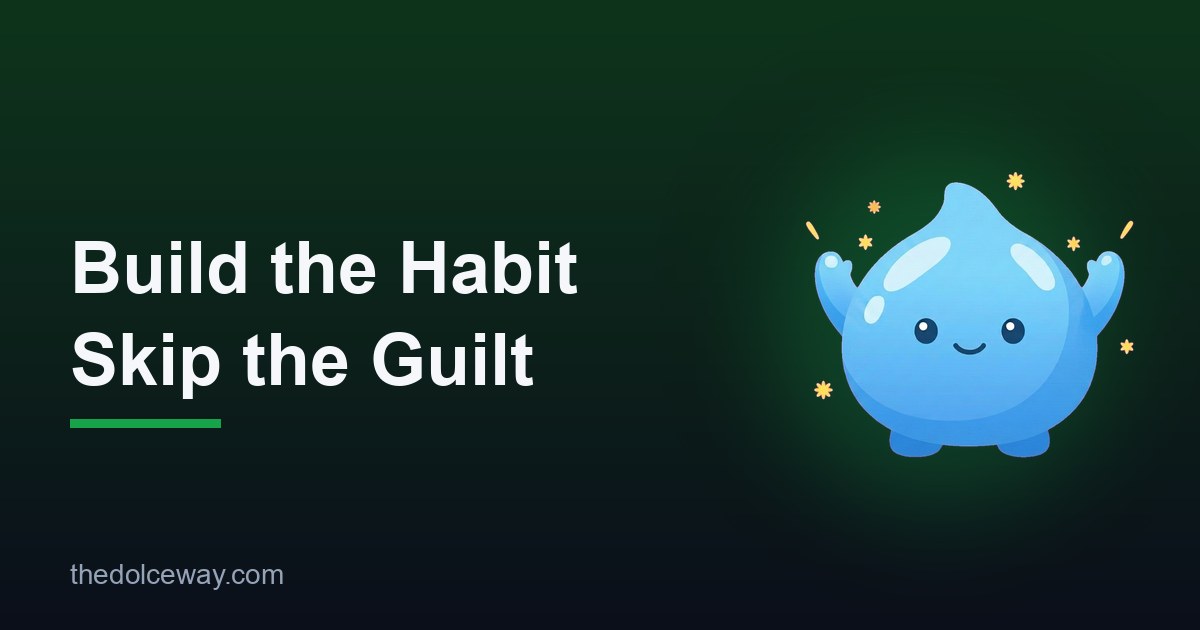
WaterDrop’s mascot, Droplet, only has good states. It celebrates when you hit your goal. It sleeps during your quiet hours. There is no sad Droplet, no crying Droplet, no wilted Droplet, because there’s a build check in the app’s codebase that fails on purpose if anyone ever tries to add one. That’s not a marketing line, it’s a rule baked into how the app ships.
The logic is simple: a tool you’re supposed to open every day should never make you dread opening it.
What a normal bad week actually looks like
You get slammed at work on Tuesday and forget to log anything after 11am. Wednesday you’re traveling and your usual cups aren’t around. Thursday you just forget, no excuse, you were busy and it slipped your mind. That’s not a failure, that’s an ordinary week for most people with a job, a family, or both.
A tracking system that assumes every week looks like your best week will always eventually feel like it’s judging you. One built around the assumption that you’ll have a Tuesday like that sometimes is the one that’s actually still there a year later.
Building it in the first two weeks
The mechanics that actually move the needle, in order of impact:
- One-tap logging. If logging a drink takes more than one tap, you’ll skip it on your busiest days, which are exactly the days you need the habit most.
- Custom cups. Log “my mug” or “my bottle” instead of typing a number every time. Less friction, more consistency.
- A visible streak, not a visible ounce count. Counting exact ounces is tedious and most people quit within a week of trying. A yes-or-no streak (did I hit my goal today) is easier to sustain.
- A grace day built in. So one missed day doesn’t undo two weeks of consistency.
- Backfill when you forget. History editing means a day you genuinely forgot to log doesn’t have to become a permanent gap or a fake entry.
None of this requires discipline you don’t already have. It requires a system that doesn’t fight you the first time you have a normal, imperfect week.
FAQ
Why do I keep failing to build a water drinking habit? Usually it’s not willpower, it’s friction and punishment. Hard-to-reach water, tedious logging, and streak systems that reset to zero on one bad day all quietly kill the habit before it forms.
Do guilt mechanics like wilting plants actually work? They work briefly and then backfire. People don’t complain about feeling guilty, they just stop opening the app. Silent abandonment is worse for the habit than an honest missed day.
What’s a grace day in a streak tracker? A grace day lets one missed day pass without resetting your whole streak to zero. It’s the difference between a system that expects a perfect life and one built for a real one.
How long does it actually take to build this habit? There’s no single number that applies to everyone, and chasing a specific day count is its own trap. What matters more than a target date is whether your system survives a bad week without making you want to quit, because that’s what actually determines whether the habit outlasts your initial motivation.
Does history editing defeat the purpose of tracking? No, it does the opposite. Being able to backfill a day you forgot to log means an honest gap doesn’t force a choice between a fake entry and a broken streak. Accurate history matters more than a streak that only looks perfect because you never look back at it.
Related reads:
- 5 Best Water Reminder Apps for iPhone: where guilt-mechanic apps rank and why
- Water Reminder App Without the Nagging: the notification side of this same problem
- iOS Water Tracking Widget Guide: cutting logging down to zero friction
Sources
- Institute of Medicine — Dietary Reference Intakes for Water
- Harvard T.H. Chan School of Public Health — The Nutrition Source: Water
This article is general information, not medical advice. Talk to a qualified professional about anything affecting your health.
— Dolce
Comments
Comments powered by Giscus. Sign in with GitHub to comment.