Your back hurts. You can deadlift 300 pounds but you threw it out picking up a suitcase. You've been doing crunches for years and your midsection still looks and performs the same. The problem isn't effort. The problem is that most popular core gym exercises are fundamentally wrong about what the core actually does.
Here's the uncomfortable truth: your core's primary job isn't to flex your spine. It's to resist movement. To brace. To transfer force between your upper and lower body without leaking energy. Every crunch you do trains the exact opposite pattern.
Time to fix that.
What Your Core Actually Is
Forget the six-pack. Your core is a cylinder of muscle that wraps around your entire midsection:
- Rectus abdominis: The "six-pack" muscle. Spinal flexion. The one everyone trains.
- Transverse abdominis: The deep stabilizer that wraps like a corset. The most important and most neglected.
- Internal and external obliques: Rotation and lateral flexion. Critical for any twisting movement.
- Erector spinae: Your lower back muscles. Yes, these are core muscles. Stop ignoring them.
- Diaphragm and pelvic floor: The top and bottom of the cylinder. They regulate intra-abdominal pressure.
When all these muscles fire together, you create a rigid trunk that protects your spine and transmits force efficiently. When they don't, you get herniated discs, SI joint pain, and a deadlift that plateaus forever.
The Best Core Gym Exercises (Ranked by Function)
Anti-Extension: Resisting Spinal Arching
Ab Wheel Rollouts The single best core exercise most people will ever do. Period. Start from your knees, roll out until your arms are extended, and pull back without letting your lower back arch. If you can do 3 sets of 12 from your knees with perfect form, you have a stronger core than 90% of gym-goers.
Progression: kneeling partial range > kneeling full range > standing partial range > standing full range.
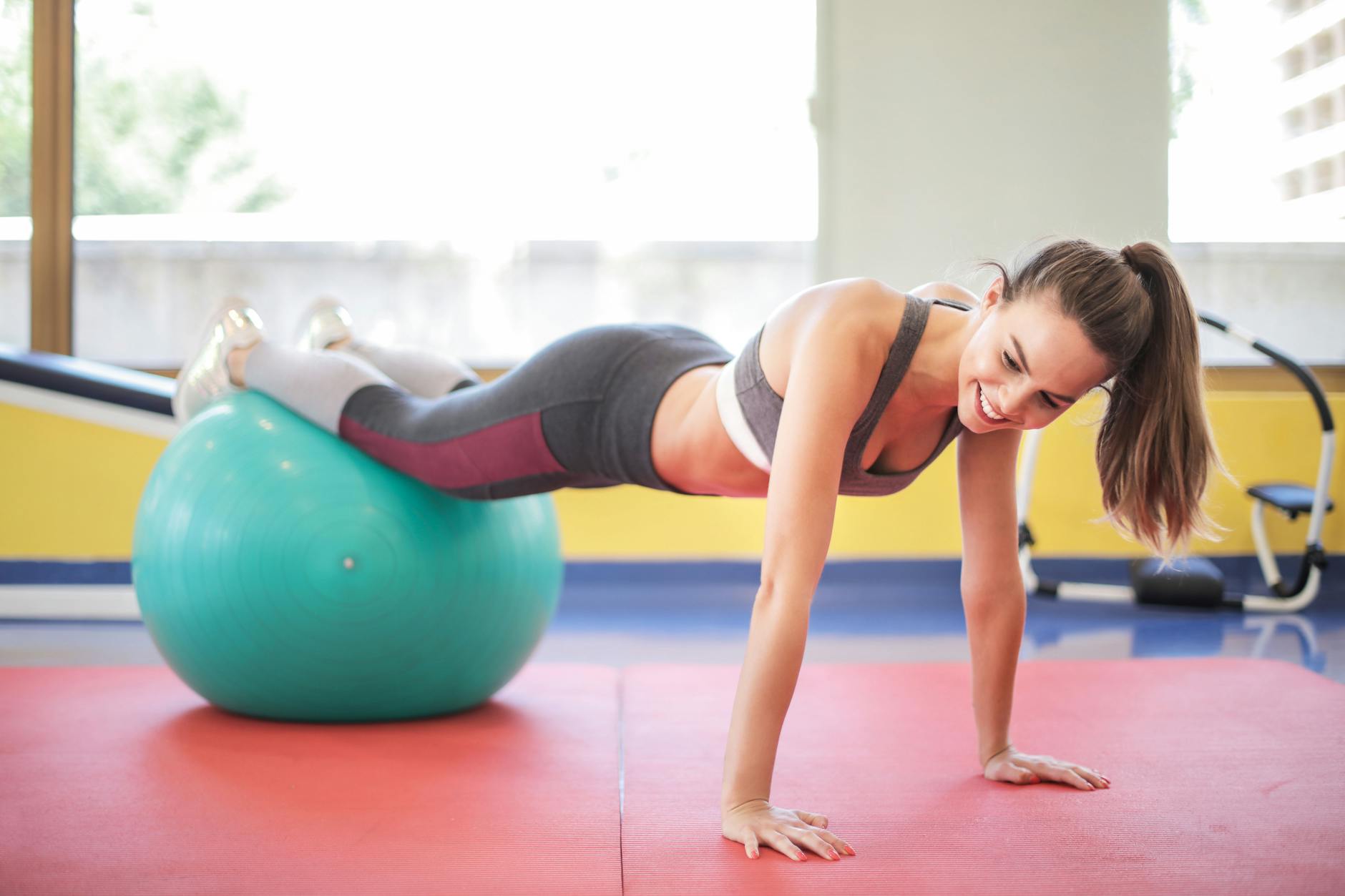
Plank Variations Basic planks are fine for beginners but become useless quickly. Once you can hold 60 seconds, stop adding time and start adding difficulty. Long-lever planks (arms extended overhead), body saw planks (rocking forward and back on toes), and plank pull-throughs with a kettlebell are legitimate core gym exercises that maintain the anti-extension challenge.
Anti-Rotation: Resisting Twisting Forces
Pallof Press Stand perpendicular to a cable machine. Hold the handle at chest height. Press it straight out. The cable tries to rotate your torso. You resist. That's it. Simple, devastatingly effective, and almost nobody does it.
3 sets of 10-12 each side. Keep your hips square. Don't let the cable win.
Single-Arm Farmer's Carry Grab one heavy dumbbell. Walk 40 yards. Your obliques will scream trying to keep you upright. This is functional core training at its purest -- your core stabilizing your trunk under load while you move through space.
Anti-Lateral Flexion: Resisting Side Bending
Suitcase Carry Same as the single-arm farmer's carry but with intent. Think about keeping your shoulders perfectly level. The weight wants to pull you to one side. Your core fights it. Walk slow. Go heavy.
Side Plank with Hip Dip Standard side plank but you lower your hip to the floor and drive it back up. Targets the obliques and quadratus lumborum -- a deep muscle that's responsible for more lower back pain than most people realize.
Rotation: Controlled Twisting Under Load
Cable Woodchops High-to-low and low-to-high. The key is that the rotation comes from your thoracic spine and hips, not your lumbar spine. Keep your lower back locked. Rotate through your ribcage. If your belly button is turning with your shoulders, you're doing it wrong.
Medicine Ball Slams Not technically rotation for the standard version, but rotational slams (slamming to one side) are phenomenal for athletic power. Explosive, satisfying, and one of the few core gym exercises that train rate of force development.
The Program: 3 Days Per Week
Don't do all of these in one session. Rotate through them across the week:
Day 1 (Anti-Extension Focus):
- Ab wheel rollouts: 3 x 8-12
- Dead bugs: 3 x 10 each side
- Plank pull-throughs: 3 x 8 each side
Day 2 (Anti-Rotation/Lateral Focus):
- Pallof press: 3 x 10 each side
- Suitcase carry: 3 x 40 yards each side
- Side plank hip dip: 3 x 12 each side
Day 3 (Rotation + Power):
- Cable woodchops: 3 x 12 each side
- Rotational med ball slams: 3 x 8 each side
- Single-arm farmer's carry: 3 x 40 yards each side
Log every session. Track the weights, reps, and distances. Use a tool like Gym Coach to stay organized and ensure you're progressively overloading. A core exercise that doesn't get harder over time stops producing results.
The Exercises You Should Stop Doing
I'll say it: stop doing sit-ups. Stuart McGill, the world's leading spine biomechanist, has demonstrated conclusively that repeated spinal flexion under load is a primary mechanism for disc herniation. Every sit-up is one more flex-cycle on your lumbar discs.
Also stop:
- Russian twists with a rounded back. If your lower back is curved and you're whipping a weight side to side, you're grinding your discs, not training your obliques.
- Superman holds. Hyperextending your lumbar spine under load is just as bad as flexing it. Do bird dogs instead.
- Hanging leg raises with momentum. If you're swinging, you're training hip flexors, not abs. Slow and controlled or don't bother.
Why Core Strength Matters Beyond the Gym
A strong core isn't a vanity project. It's the foundation that makes everything else work. Picking up your kid without tweaking your back. Carrying groceries up three flights of stairs. Playing recreational sports without getting injured.
A comprehensive home workout guide should always include core training as a non-negotiable component. It's not the glamorous stuff. Nobody posts their Pallof press PRs on social media. But it's the difference between a body that performs and one that breaks down.
Train your core like it matters. Because it does.
-- Dolce

Comments
Comments powered by Giscus. Sign in with GitHub to comment.