You have done a thousand crunches. Your abs still do not look like anything. Your lower back hurts. And you are starting to wonder if genetics just dealt you a bad hand.
It is not genetics. It is your ab workout routine. The one you pulled off Instagram. The one with thirty-seven exercises, zero progressive overload, and a thumbnail of someone who got their physique from compounds and caloric discipline, not from bicycle crunches.
Let me give you something better.
Why Your Ab Workout Routine Is Not Working
The core training industry runs on one big lie: that more exercises equal more results. Every "10-minute ab blast" video throws eight to twelve movements at you. You rush through each one, form deteriorates, and the only thing that burns is your hip flexors.
Your abs are muscles. They respond to the same principles as every other muscle. Progressive overload. Adequate resistance. Sufficient volume. Proper recovery. You do not train your chest with fifty different movements at bodyweight. Stop doing that to your abs.
The other problem is that most people confuse visible abs with strong abs. They are related but not identical. Visible abs require low body fat. Strong abs require intelligent training. A good ab workout routine builds genuine core strength. The visibility part happens in the kitchen.
The Four Movements You Actually Need
A complete core routine needs to train four patterns: anti-extension, anti-rotation, flexion, and anti-lateral flexion. That is it. Four movements. Twice a week. Progressive overload over time.
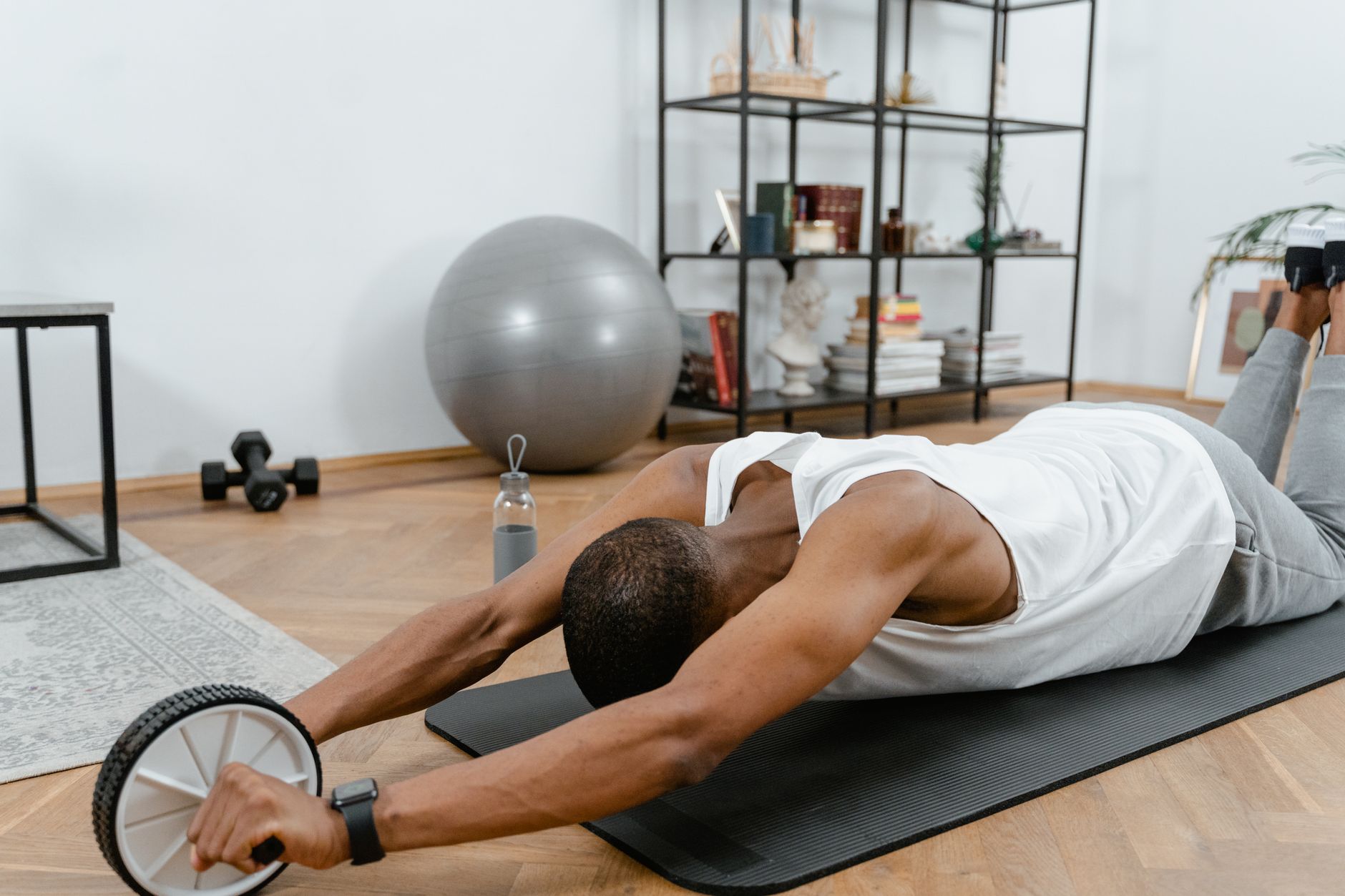
Anti-extension: Ab Wheel Rollouts. Nothing loads the rectus abdominis under stretch like a rollout. Start from your knees. Keep your ribs down and pelvis tucked. Roll out only as far as you can control. If your lower back arches, you have gone too far. Three sets of eight to twelve reps. Add range of motion before adding reps.
Anti-rotation: Pallof Press. Cable or band. Step away from the anchor point. Press your hands straight out from your chest. Hold for three seconds. The resistance wants to rotate you. Your obliques say no. Three sets of ten per side. Increase resistance when it gets easy.
Flexion: Hanging Leg Raises. Not knee raises. Full leg raises with a posterior pelvic tilt at the top. If you cannot do those yet, start with hanging knee raises and work up. This is the closest thing to a crunch you need in your program. Three sets of eight to fifteen reps.
Anti-lateral flexion: Suitcase Carries. Pick up a heavy dumbbell or kettlebell in one hand. Walk. Stay upright. Do not lean. Your obliques and quadratus lumborum will light up. Three sets of forty-meter walks per side. Add weight when your posture stays perfect.
That is the entire ab workout routine. Four exercises. Fifteen to twenty minutes. Twice a week. Done.
Programming Your Ab Workout Routine Into Your Week
Do not give abs their own day. That is wasted scheduling. Tack this routine onto the end of two of your existing training days. Lower body day and upper body day work well. Or any two sessions with at least forty-eight hours between them.
The order matters. Rollouts first because they are the most demanding. Pallof press second. Hanging leg raises third. Carries last because grip fatigue from the raises will not affect them.
Warm up with a sixty-second dead bug hold before you start. It activates the deep stabilizers and teaches your brain to brace properly.
If you are training at home without a cable machine or pull-up bar, you can still build a brutal core. The home workout guide covers equipment-free alternatives for every pattern. And the Gym Coach app will program your sets, reps, and rest periods so you do not have to think about it.
Progressive Overload for Abs
This is where everyone fails. They do the same routine at the same difficulty for months and wonder why nothing changes.
Week one, you can barely do eight rollouts from your knees to half range. Week twelve, you should be doing full-range rollouts for twelve reps. Week twenty-four, you might be doing standing rollouts. That is progress. That is how muscle grows.
For rollouts, increase range of motion first, then reps, then progress to standing. For Pallof press, increase resistance in small increments. For hanging leg raises, move from knee raises to straight leg raises to weighted raises. For carries, add five pounds when form stays clean.
Log your numbers. If you are not tracking, you are guessing. And guessing does not build a strong ab workout routine into a strong core.
The Nutrition Reality Check
I would be lying to you if I said training alone reveals abs. It does not. For most men, abs become visible around twelve to fifteen percent body fat. For most women, eighteen to twenty-two percent. You can have incredibly strong abs hiding under a layer of body fat.
That is fine. Train them for strength and function regardless. A strong core prevents back injuries, improves posture, and makes every compound lift better. The aesthetic part is a bonus that comes from sustained caloric discipline.
Use a calorie calculator to find your actual maintenance calories. Then make a small deficit if visibility is your goal. The Calorie Calculator app keeps the tracking simple and consistent.
What to Drop From Your Current Routine
Crunches. Side bends with light dumbbells. Russian twists with no weight. Planks held for three minutes. Mountain climbers done at cardio pace. Any exercise where you feel the burn but cannot add resistance over time.
Burn is not a signal of muscle growth. It is a signal of metabolic stress. Metabolic stress plays a role, but without mechanical tension and progressive overload, it produces very little actual adaptation.
Keep it simple. Four movements. Progressive overload. Twice a week. Give it twelve weeks and your core will be stronger than it has ever been. Whether you can see it depends on what you eat.
Every great physique is built on a strong core. Not the Instagram kind where someone flexes in perfect lighting after a pump. The functional kind where you can brace under a heavy squat, absorb a hit in a sport, and pick up a couch without worrying about your back. That is what a real ab workout routine delivers. The visible six-pack is just a side effect of doing the work and eating like an adult.
-- Dolce

Comments
Comments powered by Giscus. Sign in with GitHub to comment.