Here's the scene: you finish your last set of bench press, glance at the clock, and realize you have 15 minutes before you need to leave. So you lie down on a mat and do some half-hearted crunches, call it core work, and leave. That's not an ab workout in gym — that's guilt management.
A real ab session uses the equipment around you. Cables. Bars. Benches. Plates. The gym is full of tools that can load your core harder than anything you'd do on your bedroom floor. Yet the ab station at most gyms is just a stack of mats and a single decline bench from 2004.
The routine below takes 20 minutes, uses four exercises, and will be harder than anything you've tried. Let me show you exactly how to run it.
The 20-Minute Ab Workout in Gym
This routine hits all four core functions: spinal flexion (crunching), anti-extension (resisting arching), hip flexion (leg raises), and anti-rotation (resisting twisting). You do them in order. Rest 60 seconds between sets. No supersets — you want max effort on each exercise.
Exercise 1: Cable Crunch — 3 Sets of 12-15 Reps
Attach a rope to a high pulley. Kneel facing the machine. Hold the rope at your forehead. Crunch your chest toward your knees by flexing your spine — don't just bow at the hips. The weight should be heavy enough that 15 reps is genuinely hard.
Start around 50 lbs and adjust. Most people go way too light on these because they've never done a loaded spinal flexion exercise before. Your abs can handle serious weight.
Exercise 2: Hanging Knee Raise — 3 Sets of 10-15 Reps
Hang from a pull-up bar with a dead hang. Bring your knees up past 90 degrees until your pelvis tucks underneath you. Lower slowly. No swinging.
The pelvic tuck at the top is everything. If you stop at 90 degrees, your hip flexors do the work. That extra 20 degrees of tilt is where your rectus abdominis fires hardest. Think about pulling your belt buckle toward your chin.
Once bodyweight gets easy, hold a light dumbbell between your feet or strap on ankle weights.
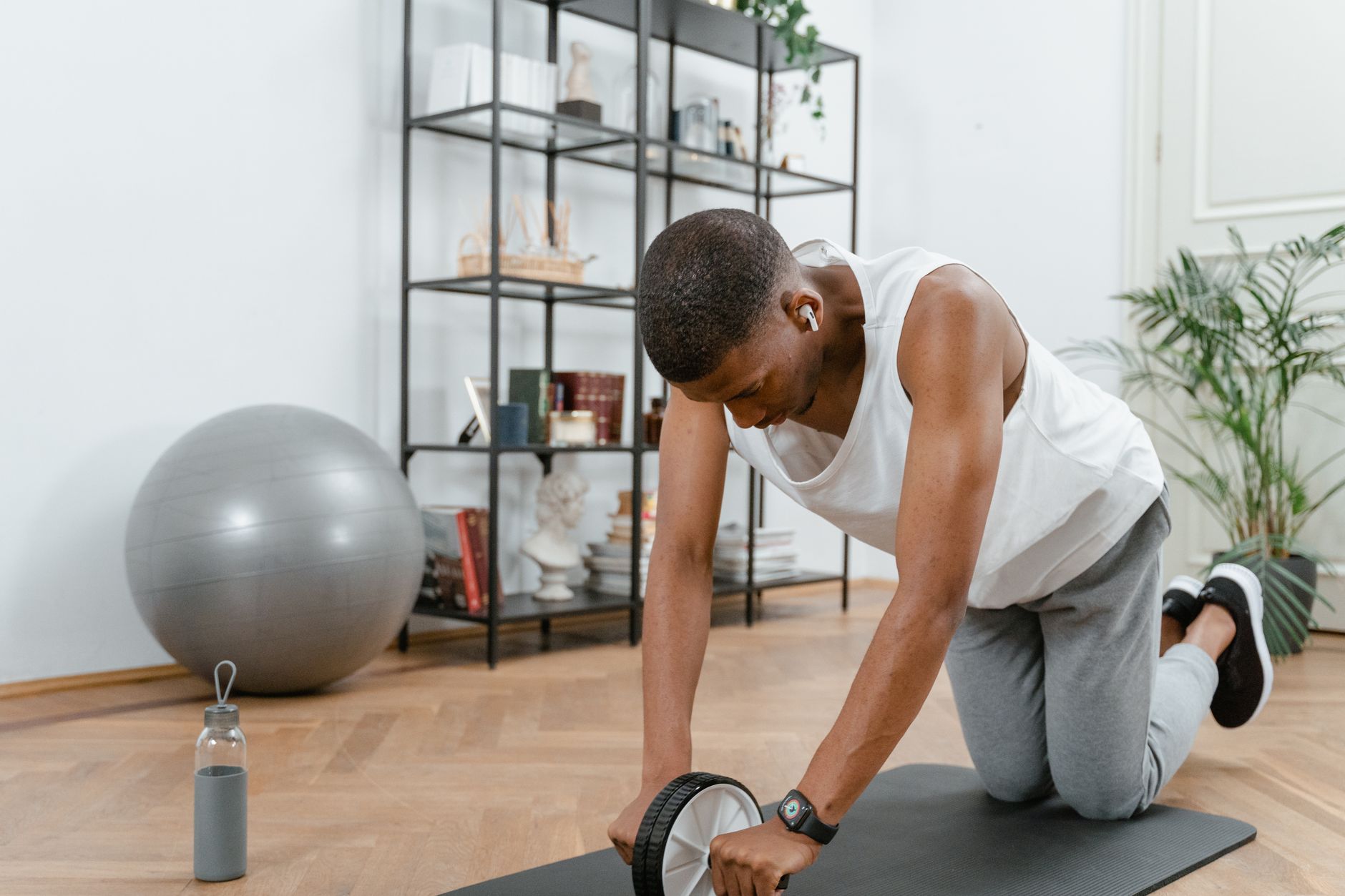
Exercise 3: Ab Wheel Rollout — 3 Sets of 8-12 Reps
Kneel behind an ab wheel. Roll forward until your body is nearly flat, arms fully extended. Pull back to start using your abs. Keep your lower back from sagging — the moment it dips, your set is done regardless of rep count.
If your gym doesn't have an ab wheel, use a barbell loaded with round plates on a smooth floor. Same movement pattern. Or grab a stability ball and do ball rollouts — slightly easier but still effective.
This is the hardest exercise in the routine. Three sets of 8 good reps beats three sets of 15 sloppy ones.
Exercise 4: Pallof Press — 3 Sets of 10 Per Side
Set a cable at chest height. Stand sideways to the machine. Hold the handle at your sternum. Press it straight out and hold for 2-3 seconds. Return. Your entire core fights the rotational pull.
This doesn't feel like a traditional ab workout in gym terms. There's no burn, no flexion, no visible movement. But anti-rotation is critical for a complete core and for protecting your spine during heavy compound lifts. Don't skip it because it looks easy.
How to Progress This Ab Workout in Gym
Week 1-2: Learn the movements. Use moderate weight. Focus on feeling your abs contract on every rep.
Week 3-4: Increase cable crunch weight by 10 lbs. Add reps to hanging knee raises. Extend the range on rollouts.
Week 5-6: Increase cable weight again. Switch from knee raises to straight-leg raises. Add a pause at full extension on rollouts.
Week 7-8: Push all exercises to the top of their rep ranges. If you hit 15 reps on everything, increase resistance across the board.
This is the part most people miss. They do the same ab workout in gym for six months with the same weight and wonder why nothing changes. Your abs are skeletal muscle. They grow through progressive overload. Track the numbers.
For systematic tracking of your ab progression alongside your full training program, GymCoach makes it dead simple to log sets, reps, and weight so you're never guessing whether you actually improved. And if you want additional bodyweight core work for off days, our home workout guide has a full section on equipment-free training.
When to Do This Routine
After your main lifts, two to three times per week. Never before heavy squats or deadlifts — fatigued abs compromise your bracing and put your lower back at risk.
The best days to slot this in are after upper body sessions. Your core won't be pre-fatigued from heavy bracing, so you can actually push hard.
Monday after push day. Thursday after pull day. That's two sessions, roughly 40 minutes of total ab work per week. More than enough if you're using real resistance.
The Unsexy Truth
Consistency beats intensity every time with abs. This routine isn't flashy. There are no bosu ball circus tricks or "ab blaster" infomercial moves. It's cables, bars, a wheel, and progressive overload. Same principles that build every other muscle.
Do this twice a week for eight weeks. Take progress photos. You'll see the difference.
-- Dolce

Comments
Comments powered by Giscus. Sign in with GitHub to comment.