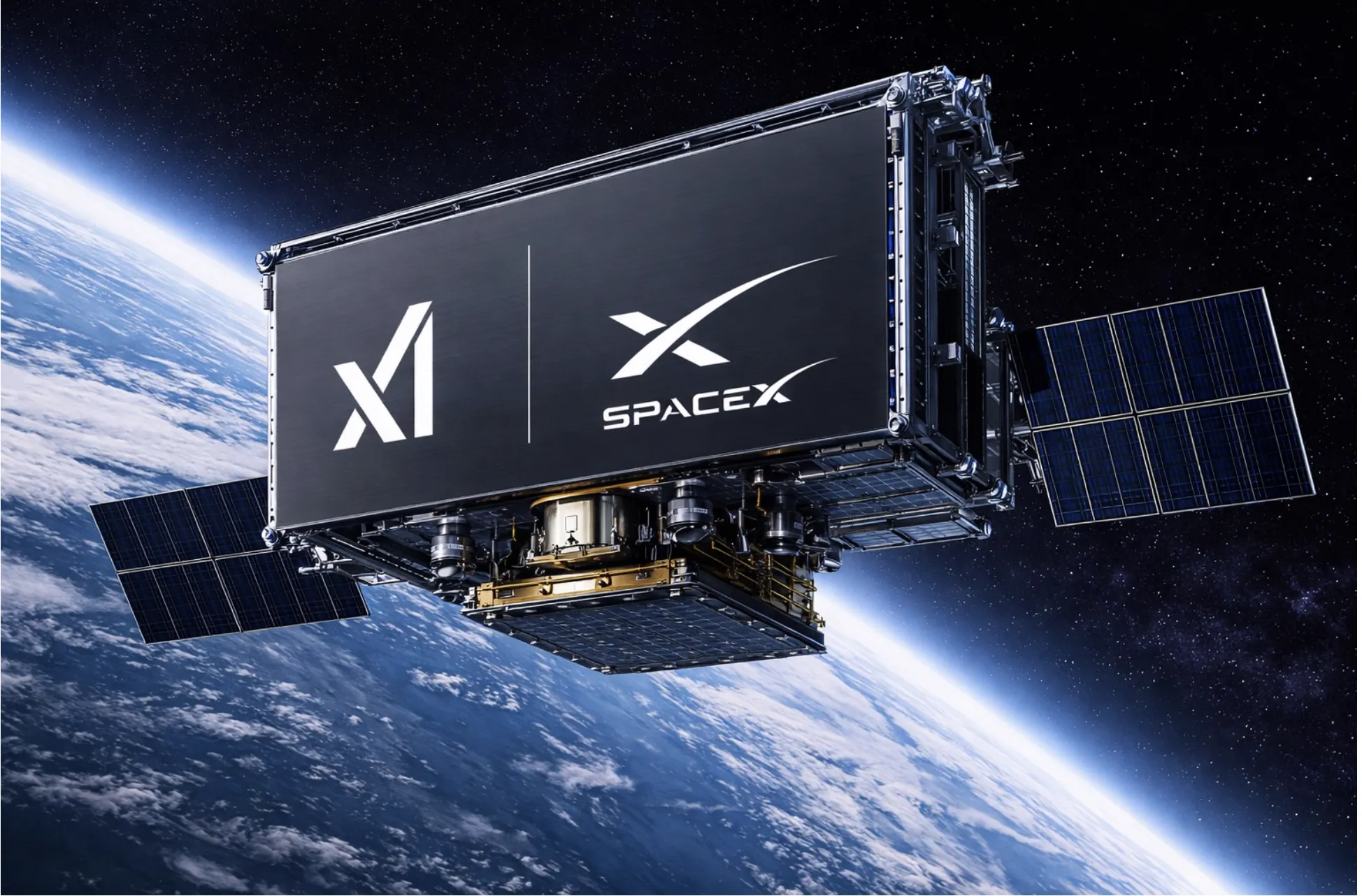
$1.25 trillion.
That’s the combined valuation of SpaceX and xAI after the biggest merger in the history of business.
Not tech. Business. Period.
The previous record was Vodafone buying Mannesmann in 2000 for $203 billion. Musk just 6x’d it.
The Deal
SpaceX acquired xAI in an all-stock deal announced February 2nd.
- SpaceX valued at $1 trillion
- xAI valued at $250 billion
- Share exchange ratio: 1 xAI share = 0.1433 SpaceX shares
- xAI share price: $75.46 | SpaceX share price: $526.59
For context:
- OpenAI’s last valuation: $500 billion
- Anthropic’s latest term sheet: $350 billion
- xAI pre-merger: $230 billion
Musk just leapfrogged everyone. Not by building a better model. By merging infrastructure.
Why This Happened
One sentence from Musk’s memo explains everything:
“My estimate is that within 2 to 3 years, the lowest cost way to generate AI compute will be in space.”
Read that again.
SpaceX recently asked the FCC for authorization to launch up to 1 million satellites. Not for internet. For orbital data centers.
The thesis: solar power in space is 24/7, no weather, no land costs, no permitting delays. Launch costs keep dropping. Computing in orbit becomes cheaper than computing on Earth.
Insane? Maybe. But SpaceX has a track record of making insane things work.
What Musk Actually Built
After this merger, here’s what sits under one roof:
- SpaceX — cheapest launch provider on Earth, Starlink satellite network
- xAI — Grok chatbot, frontier AI models, competing with OpenAI and Anthropic
- X (formerly Twitter) — social media platform, acquired by xAI in March 2025 for $33 billion
Launch capacity + satellite connectivity + AI models + distribution platform.
That’s not a company. That’s infrastructure for the next era.
The Money Problem xAI Had
Here’s the part people don’t talk about: xAI was burning $1 billion per month.
A billion. Per month.
Building frontier AI models isn’t cheap. The compute costs are astronomical. xAI was in an arms race with OpenAI and Anthropic, and it was the smallest of the three by revenue.
SpaceX generated $8 billion profit on $15-16 billion revenue in 2025. That cash flow now backstops xAI’s burn rate.
This merger wasn’t just strategic. It was survival. xAI needed a sugar daddy, and SpaceX had the balance sheet.
The IPO That’s Coming
This merger is the pre-game. The main event is the SpaceX IPO.
Reports say Musk is targeting mid-June 2026 — timed with his birthday and a planetary alignment, because of course it is.
Projected raise: up to $50 billion at a valuation of $1.5 trillion.
If that happens, it would be one of the largest IPOs in history. And every SpaceX investor — including xAI shareholders who converted — gets liquid.
What About Tesla?
Notable: Tesla is NOT part of this merger.
Tesla invested $2 billion in xAI last month. That investment now converts to an indirect stake in the SpaceX-xAI entity. Tesla shareholders effectively own a tiny piece of SpaceX through that investment.
Musk’s empire now has two clear sides:
- SpaceX-xAI-X: Space, AI, social media
- Tesla: Vehicles, energy, robotics (Optimus)
Two conglomerates. One man. The question every regulator is asking: is this too much power in one place?
What This Means for Founders
Three takeaways:
1. Infrastructure wins. Musk didn’t build the best AI model. He built the infrastructure to make AI models cheaper to run. Launch costs. Satellite networks. Data centers in orbit. The model matters less than the compute it runs on.
2. Vertical integration is back. The biggest companies in AI won’t be model-only. They’ll own the full stack — hardware, compute, distribution, platform. OpenAI partners with Microsoft. Google has TPUs. Now Musk has rockets.
3. Cash flow funds moonshots. SpaceX’s $8 billion in profit funds xAI’s $1 billion monthly burn. If you’re building something expensive, you need a cash engine to sustain it. That’s why the smartest founders build a profitable business first, then fund the moonshot with the profits.
The era of AI-only companies might be ending. The era of AI-infrastructure companies is beginning.
Related reads:
- 6 AI Facts — the numbers driving the shift
- AI: Hype to Pragmatism — what’s actually profitable
- Waabi $750M Raise — AI meets the physical world
— Dolce
Comments
Comments powered by Giscus. Sign in with GitHub to comment.